Showing posts with label Seafood. Show all posts

April 10, 2012

Ghalieh Mahi - Southern Iranian Spicy Fish & Herb Stew

Ghalieh Mahi

This is my first recipe post after Nowruz, and I can't think of a more fitting dish to share than the ghalieh mahi, the beloved fish stew of my home region of southern Iran. This dish isn't just delicious, it's deeply nostalgic. The aroma of freshly chopped cilantro, fenugreek, and garlic simmering in a spicy tamarind sauce with tender, firm pieces of fish takes me back to childhood. 

A few weeks into the spring season, I am reminded of Khuzestan's fleeting but perfect season, fields dotted with red laleh (tulips), shaghayegh (red poppies), and wildflowers covering the hillsides. Most years, relatives and family would visit us for the Nowruz holidays. My parents, both very sociable, loved welcoming people into our home. During those busy days, my mother's cooking was more delicious than ever, or at least that's how I remember it.

There are different variations of قلیه ماهی ghalieh mahi, but the main ingredients are fresh گشنیز geshniz (cilantro) and شنبلیله shanbalileh (fenugreek). If you can't find fresh fenugreek, don't skip it; it's essential to the dish. Dried fenugreek is available in Persian markets, and fresh fenugreek can often be found at Indian grocery stores. Tamarind pulp is another defining ingredient, giving the stew its tang. I recommend buying packaged pulp, soaking it in hot water, and removing the seeds and fibers by hand rather than using ready-made paste. 

The choice of fish matters too. Traditionally, it's made with southern Iranian varieties like sangsar, hamoor, shoorideh, but any firm white fish without small bones works beautifully. It just needs to hold its shape as it simmers. For me, ghalieh mahi is at its best when heavy on the garlic, with enough red pepper to add real heat. In the recipe below, I've listed the amount I typically use, but I encourage you to adjust the garlic, chili, and tamarind to your own taste.

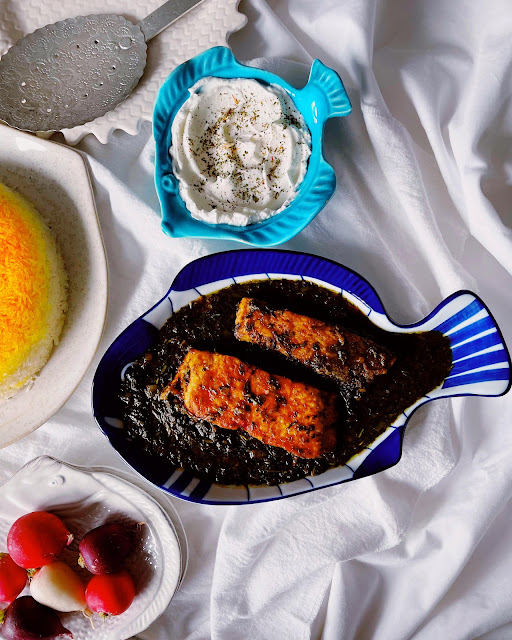
Ghalieh Mahi

Ghalieh Mahi - Southern Iranian Spicy Fish & Herb Stew


Ingredients
Serves 4-6

-2 pounds fish fillet (salmon, snapper, tilapia, halibut, cod) or any fish of your choice, cut into small pieces
-3 cups fresh cilantro, finely chopped
-1 cup fresh fenugreek, finely chopped or 2 tablespoons dried fenugreek
-7 garlic cloves, finely minced
-2 medium onions, finely diced
-6-ounce tamarind pulp with seeds or 2 tablespoons tamarind concentrate 
-1 teaspoon red pepper powder (adjust to taste)
-1 teaspoon turmeric powder
-2 tablespoons all-purpose flour
-Salt and pepper to taste
-6 tablespoons vegetable oil or olive oil

Method
  1. Place the tamarind in a small bowl, cover with 1-2 cups of hot water, and let it soak for about 20 minutes. Once cool enough to handle, squeeze and separate the pulp from the seeds and fibers, then strain through a sieve. Set aside.
  2. In a bowl, mix the flour with 1/2 teaspoon of turmeric, 1/2 teaspoon of salt, 1/4 teaspoon of black pepper, and 1/2 teaspoon of red pepper. Coat the fish with the flour-turmeric mixture and let rest for 15-20 minutes. Shake off any excess flour before frying.
  3. Heat 3 tablespoons of oil in a skillet over medium heat. Gently saute the fish on all sides until lightly golden. Set aside.
  4. In a large pan, heat the remaining oil. Sauté the onions over medium heat until translucent. Add 1/2 teaspoon of turmeric and the minced garlic, then cook for an additional 2-3 minutes over medium-low heat.
  5. Stir in the cilantro and fenugreek, and saute with the onion and garlic for about 10 minutes.
  6. Pour in the tamarind liquid and gently simmer over medium-low heat for 15-20 minutes, until all the flavors have come together.
  7. Carefully place the fish pieces into the stew. season with additional salt, pepper, and red pepper to taste. Add a little more hot water to the stew if the stew is too thick. Cover and cook for another 15 minutes on low heat without stirring. 
Serve hot with basmati rice.

Enjoy!


March 09, 2012

Mahi - Fish (Fried, Smoked or Baked) Persian New Year's Day Lunch/Dinner


A traditional Nowruz lunch or dinner always includes a platter of sabzi polow (mixed herb rice) served with ماهی mahi (fish). The fish is usually served either doodi (smoked or salted) or sorkh kardeh (pan-fried). 

Iran is home to many varieties of fish from Darya-ye Khazar (Caspian Sea) in the north and khalij-e Fars (Persian Gulf) in the south, and each region has its own local favorites. In the past, any delicate seafood from these coastal regions rarely reached the Caspian Sea or the Persian Gulf, and would not have traveled far without spoiling. Unlike today, when most ingredients are available year-round, fresh seafood was once a rare luxury for those living away from the coasts. To preserve fish and shrimp, Iranians relied on salting, smoking, and drying long before the invention of modern refrigeration. 

Ancient Persians were remarkably innovative: as early as 400 BC, they had developed yakhchals (ice-pits), mud-brick domes used to store ice and food through the heat of summer.

Among the most prized fish for the Nowruz feast is ماهی سفید mahi sefid (whitefish) from the Caspian Sea region. Its popularity has spread throughout Iran thanks to modern refrigeration, which makes it accessible across the country. Though mahi sefid is known for its many bones, its pin bones are easy to remove. For this recipe, I've chosen three types of fish with three different preparation methods.


The most important Nowruz tradition in our home growing up, besides gathering around the haft-seen table in our new clothes at the time of sal-e tahvil (spring equinox), was the Nowruz lunch! My father, who never liked fish of any kind, would bring a large mahi doodi (smoked whitefish) and also some sort of fresh local mahi jonoob (fish from the south). He liked his Nowruz whitefish pan-fried, brown and crispy, and it was always served with sabzi polow and kookoo sabzi. Here's another recipe for kookoo sabzi with walnuts, and also my first recipe for sabzi polow mahi.

1- Mahi Sorkh kardeh - Fried Fish

Ingredients

Serves 4

-4 pieces (2lb) flounder fillets, or any fish of your choice, scales/skin removed
-1/3 cup all-purpose flour
-1 teaspoon dried fenugreek leaves, crushed
-Salt and black pepper to taste
-1/4 teaspoon red pepper powder 
-1/4 teaspoon garlic powder 
-A pinch of turmeric powder 
-2 tablespoons butter
-1/4 cup olive oil
-2 limes or a large narenj (Seville orange)

Method:
  1. Rinse fish under cold water and pat dry.
  2. Season the fillets with salt, pepper, garlic powder, and dried fenugreek leaves.
  3. In a large frying pan, melt the butter and add the oil on medium-high heat. 
  4. In a bowl, combine the flour with a small amount of turmeric. Lightly coat the fillets in the flour mixture, shaking off any excess before placing them in the hot pan. Fry the fish on both sides until golden brown and crispy.
  5. Remove from heat and transfer to a serving platter. Squeeze fresh lime juice or juice of a Seville orange over the fish.
Serve with sabzi polow (mixed herb rice), salad, and torshi.

***

If you find smoked fish to be too salty, simply rinse it under cool running water for a few minutes and pat it dry. I like to wrap smoked fish in aluminum foil with a handful of fresh and dried herbs, then bake it for 10-12 minutes.

2- Mahi Doodi - Smoked Whitefish

Ingredients:

-2 pounds smoked whitefish
-1 tablespoon flour,
-1 tablespoon dried dill weed
-1 teaspoon dried fenugreek leaves
-A few sprigs of fresh parsley, dill, and chives, finely chopped
-1-2 limes
-Olive oil

Method:
  1. Squeeze the limes all over the fish, inside and out.
  2. In a small bowl, combine the flour and dried herbs. Rub the mixture inside the fish cavity.
  3. Fill the fish with fresh herbs and drizzle a tablespoon of olive oil inside.
  4. Wrap the fish in foil and place it in a preheated 350 degrees Fahrenheit for 10-12 minutes.
Serve with sabzi polow (mixed herb rice), salad, and torshi.

***

This salmon recipe is from my late mother, who never quite liked the taste of salmon and its pink color. To her, salmon always looked raw! That's why she preferred to pan-fry it first and then bake in the oven to ensure that it was fully cooked.


3- Salmon - Pan Fried and Oven-baked

Ingredients

Serves 4

-2 pounds salmon fillet, rinse under cold water, pat dry, and cut into smaller serving-size pieces
-1-2 tablespoons dried dill weed
-1teaspoon dried fenugreek leaves
-1/4 teaspoon red pepper powder (optional)
-Salt and black pepper to taste
-2 garlic cloves. finely minced
-Olive oil
-2 limes or a large narenj (Seville orange)

Method:
  1. Season the salmon with dried herbs, red pepper, salt, and black pepper.
  2. In a heavy skillet, heat 2-3 tablespoons of olive oil on medium-high heat.
  3. Lightly fry the salmon fillets on both sides for a few minutes.
  4. Transfer the fish into an ovenproof dish. You may line the bottom of the pan with thin slices of lime and place the salmon fillets on top.
  5. Add the minced garlic, drizzle a bit more olive oil over the fish, and bake in a preheated 350 degrees Fahrenheit oven for about 15-20 minutes or until the salmon is cooked through.
  6. Remove from the oven and squeeze fresh lime or Seville juice over the fish before serving.
Serve with sabzi polow (mixed herb rice), salad, and torshi.

Enjoy! Nowruz Mobarak!

May 24, 2010

Maygoo Polow-Khuzestani - Southern Iranian Spicy Shrimp & Rice


My earliest memories of shrimp go back to my childhood in Bandar Mah-Shahr, the port-city of the moon, a coastal town in the southwestern region of Khuzestan. I don't recall much about what the town looked like and what life was like beyond the walls of our home, but I vividly remember the food my mother cooked using the local shrimp. There was ghalieh maygoo, the fragrant shrimp and herb stew, and a simple spicy sauteed shrimp dish, which I still make often. And then there were these tin containers in our kitchen filled with large, salted shrimps. Those were never destined for the pot; we ate them as snacks, pulling off the heads, tails, and shells one by one, messy work, but such fun at the time.


Seafood is an essential part of the Khuzestani cuisine. And while Iranian cooking as a whole is neither hot nor particularly spicy, many dishes from Khuzestan are boldly seasoned. Of course, this varies from town to town and from one household to the next, depending on personal taste. For example, even though I grew up eating spicy food, I now cook it only rarely; when a recipe calls for hot peppers, I usually add just a pinch of red pepper flakes for a little extra zest. So feel free to adjust the heat to your liking, and add more cayenne pepper when marinating the shrimp. 

میگو پلو Maygoo Polow is a fragrant layered rice dish made with spiced, marinated shrimp. and rice. When using shrimp, fresh or frozen, make sure that they have no off-odor, especially for this dish, where rice and shrimp cook together; any unpleasant smell affects the entire pot. 

Maygoo Polow - Rice with shrimp

Ingredients

Serves 4-6

For the Rice:

-2 1/2 cups basmati rice
-Salt
-Oil
-2-3 tablespoons butter, melted (for drizzling; optional)
-1/2 teaspoon powdered saffron dissolved in 4 tablespoons hot water

For the Shrimp:

-2 cups fresh baby shrimps
-4 large garlic cloves, minced
-1/2 teaspoon turmeric
-1/2 teaspoon cumin
-1/2 teaspoon ground coriander
-1 teaspoon dried dill
-1/4 teaspoon black pepper
-1/4 teaspoon red pepper
-1/3 ground Persian limes (limoo amani)
-1/4 teaspoon dried fenugreek
-1/2 teaspoon Salt or to taste
-Oil

Method:
  1. Wash rice with cool water and soak in 6 cups of water mixed with 4 tablespoons of salt for 1-2 hours. Drain.
  2. Rinse shrimp with cool water, drain well. 
  3. In a bowl, combine the shrimp with minced garlic, black pepper, red pepper, cumin, ground coriander, dried dill, fenugreek, turmeric, ground limoo amani, and salt. Set aside in the refrigerator for 1 hour.
  4. In a non-stick pot, bring 6 cups of water to a boil. Add drained rice. Boil for about 7 minutes, until the grains are soft on the outside but still firm in the center. Drain and rinse with cool water.
  5. Wash the pot and return it to the heat. Add 4 tablespoons of oil to the bottom. Using a large spoon, layer the rice and marinated shrimp, building the mixture into a pyramid. Make a few holes in the rice so steam can escape. Cook over medium-high heat for 7 minutes, until steaming. Drizzle 2 tablespoons of melted butter, 2-3 tablespoons of water, and the saffron. Cover, reduce the heat to low, and steam for about 45 minutes. 
Serve warm on a platter with yogurt and pickles.

*Variation: Sauté a large, thinly sliced onion in 2 tablespoons of oil. Add 1 teaspoon of minced garlic, turmeric, stir, add the shrimp, salt, black pepper, red pepper, cumin, ground cilantro, dried dill, ground lime, and fenugreek, cook for a few minutes or until shrimp begin to change color. Then add the shrimp mixture over the rice after serving the rice on a platter.

Enjoy!

March 01, 2009

Sabzi Polow Mahi - Herb Rice with Fish

Iranian Sabzi Polo (Herbed Rice) with Mahi (Fish)

سبزی پلو با ماهی Sabzi polow (herbed rice) and crispy pan fried mahi (fish) is one of the main traditional meals for Nowruz - Persian New Year. There's only few weeks left before Nowruz and I'm all ready for the cold winter to be over. The weather is still very cold, the grass is brown and there are no blossoms on the trees. However, yesterday I made Sabzi polow - herbe rice with fried fish. These are traditionally served on New Year's day.

Persian Herbed Rice with Fish
Iranian Mahi (Fish) Crispy Pan Fried
Mahi- Fried Fish-Iranian-Style
Iranian Herbed Rice with Fish

Sabzi Polow Mahi - Herb Rice with Fish

Ingredients:
Serves 6

2 cups long grain (basmati) rice
1 cup chopped fresh parsley
1 cup chopped fresh dill
1 cup chopped fresh coriander
1 cup chopped fresh scallions (green parts only), use tareh instead if you can find them in markets where you live
3-4 garlic cloves
1/2 teaspoon saffron dissolved in 4 tablespoons hot water
Salt
Vegetable oil or butter
Water

Method:
  1. Clean, wash, dry and finely chop the herbs and mix them together in a large bowl. It’s better to use fresh herbs for this dish; however there is always the dried sabzi polow herb mix that you can find in Iranian grocery stores.
  2. Wash the rice with cool water a few times. Soak in 8 cups of water, add 4 tablespoons of salt and set aside for a couple of hours. In a large non-stick pan, bring 3 quarts of water to a rapid boil. Drain the rice and add to the pot. Bring water to back to a boil for about 5-7 minutes. Test to see if the rice is ready. Rice should be firm in the center and soft on the outside. Strain the rice using a colander and rinse with cool water.
  3. Wash and dry the pot and return to heat, add 4 tablespoons of vegetable oil and a few drops of liquid saffron. With a large spatula place the rice into the pot, place a layer of rice and a layer of vegetables building it into a pyramid shape. Place the peeled garlic cloves in between rice. Make 4 holes in the rice with the bottom of the spatula to release the steam. 
  4. Cover and cook for 7-10 minutes on medium-high heat until rice is steaming. Pour 2 tablespoons of oil and 2-3 tablespoons of water over the rice, lower the heat, cover and steam the rice for 50 minutes on medium-low heat.With a large scoop take some rice from the top, mix in with the dissolved saffron and set aside. Serve rice on a platter; sprinkle the mixture of rice and saffron on top.

Mahi - Fish

Ingredients:
Serves 6

6-8 pieces of white fish fillet or a fish of your choice
1 cup flour (to coat fish)
Garlic powder
A pinch of red pepper
A pinch of turmeric powder
Salt and black pepper
Vegetable oil
1 large Lime

Method:
  1. Season fish on both sides, lightly coat the fillet with flour and  shake off any excess flour.
  2. Heat 3 tablespoons of vegetable oil in a skillet over medium heat, place fish in the pan and fry until golden brown and crispy on both sides.
  3. Place the fried fish on a serving platter, squeeze lime juice over the fillets. 
Serve sabzi polow and mahi with fresh herbs, salad and pickles (torshi).

Enjoy!