Showing posts with label Persian Sweets. Show all posts

August 06, 2015

Yakh dar Behesht - Ice in Paradise

Iranian Ice In Paradise Dessert

The other day, I sat down under the pear tree in the back of our garden to take a brief break from the intense summer heat and to also enjoy the refreshing, sweet, creamy taste of یخ دربهشت  - Yakh dar Behesht. Ice in Paradise is a rice flour and milk dessert recipe infused with cardamom and rosewater and topped with pistachios. This dessert's intriguing name is a combination of the term "yakh, " meaning "ice," "dar," meaning "in," and "behesht," meaning "paradise." According to the online Encyclopedia Iranica entry on Garden, "From the time of the Achaemenid empire, the idea of an earthly paradise spread to the literature and languages of other cultures. The Avestan word pairidaeza-, Old Persian *paridida-, Median *paridaiza- (walled-around, i.e., a walled garden), was transliterated into Greek paradeisoi, then rendered into the Latin paradisus, and from there entered into European languages, i.e., French paradis and English paradise." An ancient earthly Persian Paradise consisted of a majestic castle surrounded by lush pastures, magnificent Cypress trees, a large shimmering reflecting pool covered with water lilies, and streams gently flowing through the pomegranate trees and fragrant rose bushes.


I cannot tell you much about the origin of the name of this dish -- perhaps it was given its name by a king or a queen, or a chef with a poetic mind, or even a dinner guest with a knack for exotic names. The word pardis/paradise means different things to different people. It may remind some of us of heaven above or perhaps earthly Persian-style paradise gardens. To me, paradise is a state of mind.  It is those precious moments spent with loved ones. It's when you feel safe, at peace with yourself and your surroundings. It's those heavenly moments when you sit back, relax, and can calm the mind and the inner frenzy and treat yourself to this delicious summertime treat somewhere under the small shade of a fruit tree.


Come, come, whoever you are,
Wanderer, worshiper, lover of leaving.
It doesn't matter; ours is not a caravan of despair.
Come, even if you have broken your vows a hundred times.
Come, yet again, come, come.

~ مولوی - Rumi

Whoever comes to this place, feed them and don't ask about their faith

~ خاقانی - Khaghani

Isfahanis have a special way with desserts and food in general, and I got this recipe from my sister-in-law Shahnaz, who lives in Isfahan. According to her, Yakh dar Behesht is one of the most popular desserts there.

I changed the recipe a little bit by cutting the required amount of ingredients in half. You may adjust the sugar to your liking.


Yakh dar Behesht -Ice In Paradise

Ingredients

Serves 6-8

-1 cup rice flour
-1/4 cup wheat starch or cornstarch
-4 cups whole milk
-1 1/3 cup sugar or to taste
-1/4 cup rosewater
-1 teaspoon ground cardamom


Garnish:

-Crushed pistachios
-Shredded coconuts
-Slivered almonds
-Dried rose petals

Method:

  1. In a small mixing bowl, dissolve cornstarch in 1/2 cup of cool water.
  2. Pour the milk into a heavy-bottomed saucepan over medium heat, stir in rice flour, and start stirring.
  3.  Add cornstarch and cardamom, whisk constantly until thickened to a pudding-like consistency.
  4. Add sugar while whisking continuously until the sugar is fully dissolved. Reduce the heat, add rosewater, stir, and simmer on low heat for another 2-3 minutes. 
  5. Remove from heat and pour into a large shallow glass dish, and sprinkle crushed pistachios or shredded coconuts on top. Or generously sprinkle crushed pistachios onto the bottom of the silicon molds, pour the mixture into the molds, smooth the surface, and level it out. The third option is to simply pour the mixture into individual serving bowls. 
  6. Allow to cool at room temperature, cover the dish with plastic wrap, and place in the refrigerator for 4-6 hours or until cool and set. 
Serve cold or at room temperature.


Enjoy!

March 16, 2015

Nan Panjarehi - Nowruz Window Cookies


Vernal Equinox - The first day of Spring is only a few days away, and one thing common among all Iranians is our shared passion for all things Nowruz, an ancient festival of Spring dating back 3000 years. In most households, there's a frenzied rush to complete the task of khane tekani (spring cleaning), growing sabzeh (seeds), shopping for haft seen items, and buying new clothes for the children, all before Sal-e Tahvil occurs. Nowruz is about feasting on traditional dishes such as kookoo sabzi, sabzi polow ba mahi, reshteh polow, and ash-e reshteh, among many other fresh, herb-based dishes. There's also a rich tradition of baking New Year's desserts, and each region has its own traditional shirini (sweets) to celebrate this traditional festival. Nowruz celebrations are a chance to nourish the body and the spirit by enjoying delicious meals with your family and friends.


Whether I engage in an all-out khaneh tekani or choose to minimize it down to the necessary basics, I must always remind myself of the greater message of this celebration: purifying the heart, mind, and soul. Nowruz is about starting a "New Day," rejuvenating the mind and body, purifying the heart, welcoming light and good health into your life, and getting rid of any negativity.


It has been a harsh winter here in the northeast, which makes the arrival of Spring all the more exhilarating. The force of life runs deep within the bare trees, hidden blooms, and all living things like a winding river on the way to its destination, touching, turning, and shifting everything in its path. The long-awaited joyous celebration of Nowruz (New Day) breathes optimism and joy into the world.


In our home, Nowruz was always celebrated with mouth-watering sweets, fresh seasonal fruits, and fancy ajil (Persian mixed nuts). One of my favorite Nowruz sweets that reminds me of home is nan panjerehi, crunchy and lightly sweetened cookies. نان پنجره ای  Nan Panjarehi/shirini panjarei translates to window cookies in Persian. Nan means bread, and panjareh means window, and making a window cookie is so befitting for springtime festivities. Nowruz holidays were the most beautiful time of year to be in Khuzestan province with its vast open fields of shaghayegh flowers and endless green hills.

This is an Iranian recipe with a touch of Scandinavian influence. I like that they use fewer eggs and add milk to the recipe. I opted to use 2 eggs and a cup of 2% milk. For this recipe, you'll need a rosette iron, a candy thermometer (highly recommended), and a bit of patience. Typically, the first couple of cookies will not come out right.


Nan Panjerehi

Ingredients

Makes about 40 pieces

-1 cup all-purpose flour, sifted
-1/2 cup wheat starch
-2 large eggs
-1 cup milk (I used 2% milk)
-4 tablespoons rosewater
-1/2 teaspoon ground cardamom
-Vegetable oil (canola oil)
-Powdered sugar

Method:
  1. Place the starch in a large mixing bowl, add the rosewater, and stir to blend.
  2. Break the eggs into a small bowl and beat lightly with a fork. 
  3. Add the whisked eggs, sifted flour, milk, and ground cardamom to the mixture, mix with a wire whisk until well blended and smooth.
  4. Pass the mixture through a sieve. 
  5. Cover with plastic wrap and let sit in the refrigerator for an hour.
  6. Heat 2-3 inches of oil to 375 degrees Fahrenheit in a deep pot.
  7. Heat the rosette iron in the hot oil for one minute, remove, and tap on a paper towel.
  8. Deep the iron into the batter just up to the edges, remove and place into the hot oil for 30 seconds or until golden. Remove from hot oil and place on a paper towel-lined large plate to remove any excess oil. 
Dust nan panjerehi with powdered sugar and serve.


Enjoy! Sale-e No Mobarak! Happy Nowruz!

December 18, 2014

Shab-e Yalda 2014: Baslogh Recipe to Celebrate the Persian Yalda Night


The early sunsets, short days, and long nights of autumn will come to an end this upcoming Sunday, December 21st. The earliest sunsets of the year occur during the week leading up to the winter solstice, and on the shortest day of the year, the sun sets at 4:32 PM and rises again at 7:17 AM the next day here in New York. Beginning on the 1st day of winter, the days start to grow longer, though the change is so gradual that it won't feel noticeable for several days. 

The longest night of the year is known as  Shab-e Yalda in Persian. The word Yalda means birth, and it refers to the birth of Mithra, the god of light and justice. Traditionally, the night of Yalda is celebrated with friends and family gathering around a کرسی - korsi or سفره  - sofreh (festive spread) or a table with seasonal fruits: bowls of ruby-red pomegranates, platters of sweet sliced watermelons, and ripe persimmons.  A bowl of ajil (nuts, seeds, and dried fruits), sweets, and a book of Hafez's poetry. 

This celebration usually begins after dinner and continues late into the night with poetry reading, storytelling, and music to celebrate the victory of light over darkness, the start of a new season, and to make the long hours of the night go by faster. For me, it is also a way of remembering those who kept this tradition alive through the centuries: people gathered on cold winter nights around a small oil lamp or a simple wood-burning fire, with limited food yet an abundant spirit. And still, they passed down the magic of Shab-e Yalda from generation to generation.


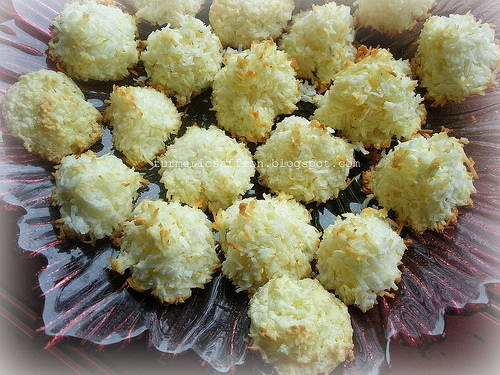
Among the sweets commonly served, baslogh is widely recognized as a classic yalda shirini (Yalda sweet). باسلوق  - Baslogh is a soft starch-based confection infused with rosewater, and each individual piece is completely coated with shredded coconuts and topped with walnuts. In addition to rosewater, saffron and ground cardamom may be used as well. For this recipe, you will need a little patience as it does require constant stirring.

Baslogh

Baslogh (Persian Rosewater Coconut Confection)

Ingredients

Makes about 14 pieces

-1/2 cup cornstarch
-1 cup (8-ounces) granulated sugar
-1 1/2 cups water
-1/2 cup rosewater
-1 teaspoon lemon juice
-1/4 cup walnut halves
-1 tablespoon unsalted butter
-1 cup sweetened shredded coconut

Method:

  1. Pour the shredded coconut into a large bowl. Set aside.
  2. In a medium saucepan, combine sugar and 1 cup of water. Bring to a boil over medium-high heat until the sugar is completely dissolved. Reduce the heat and let it simmer.
  3. In a small saucepan, mix the cornstarch and 1/2 cup of cool water together in a small saucepan. Stir until the mixture is completely smooth. 
  4. Add the dissolved cornstarch to the simmering sugar syrup. Bring to a gentle boil and stir constantly until the mixture is smooth and no longer lumpy. Reduce the heat to low and simmer, stirring frequently until thickened for about 15-20 minutes. Add the rosewater, butter, and lemon juice, and cook for another 5-7 minutes. Stirring constantly.
  5. Working quickly, drop spoonfuls of the hot mixture into the bowl of shredded coconut. Roll and shape each spoonful into a ball, coating all sides evenly in the coconut. Press a walnut half into the center of each baslogh. Arrange the pieces on a serving platter and serve with tea.

Happy Shab-e Yalda!

August 21, 2014

Ranginak - Persian Date Dessert (Recipe #2)

Ranginak

We are in the midst of خرما پزان - khorma pazan season, a term used by locals in the south of Iran when the temperature reaches its peak of 100+ degrees Fahrenheit with humidity levels over 60 percent. The air becomes heavy, and outdoor activities are almost unbearable. thus making outdoor activities unbearable. Yet, this intense heat is also a blessing. It's during khorma pazan that dates ripen fully, almost "cooked" by the sun, and become ready for harvest. 

This recipe is an ode to the traditional Khuzestani-style رنگینک ranginak, a luscious date and walnut dessert. It's simple to make, requiring only a bit of patience to stuff plump, pitted dates with lightly toasted walnuts, arrange them neatly on a platter, and then pour over a warm mixture of melted butter and flour infused with cardamom and cinnamon. The sweet taste of ranginak always brings back memories of home.

Dates have been a part of Persian cuisine for centuries. Date palms grow all along the southern coast of Iran, from Ilam and Bushehr to Fars, Khuzestan, Sistan and Baluchestan, and Kerman. To most, the pomegranate may symbolize Iran, but to me, dates are the true fruit of Khuzestan. 

Many years have passed since I lived there, but the images remain vivid: Khoramshar's vast fields of date palms, the stacks of tin buckets filled with dates stacked in small shops, the half-ripe clusters spread out on woven mats to dry under the sun, and, of course, my mother's ranginak. 


Dates were our after-school snack when we got home, and they still hold that simple comfort today. Whether they are fresh, dried, large, or small, dates pair perfectly with your hot cup of tea at any time of day. They're so addictive that you'll find yourself reaching for one with every sip, letting the sweetness of the dates mingle with the aroma and slightly bitter taste of the strong, freshly brewed loose-leaf chai. 

Naturally sweet and far more flavorful than any other fruit, dates come in many varieties. Depending on when they are harvested, they can range from unripe and crisp to partially ripe and soft, or fully ripe, each stage offering its own unique taste.


Ranginak - Khuzestani Date and Walnut Dessert

Ingredients

Makes about 24 pieces

-1 pound dates, pitted
-1/2 cup walnuts halves
-2 cups all-purpose flour
-1 cup (8 ounces) unsalted butter
-3 tablespoons powdered sugar
-1/2 teaspoon cinnamon
-1/4 teaspoon cardamom 
-2-3 tablespoons finely crushed pistachios, for garnish

Method:

  1. Toast the walnuts in a small dry skillet over medium-low heat for 3-5 minutes, stirring frequently until fragrant. Remove from the heat and let cool slightly. Gently stuff each pitted date with a walnut half and set aside.
  2. In a medium-sized skillet, toast the flour over medium heat for about 5 minutes, stirring frequently, until the edges turn a light golden brown. 
  3. Add the butter to the toasted flour and cook for 15-20 minutes, stirring constantly, until the mixture thickens slightly and turns golden brown. Add the cinnamon, cardamom, and sugar, stirring well to combine. Cook for another 5-10 minutes, then remove from heat.
  4. Spread 1/2 of the warm flour-butter mixture evenly on th bottom of the serving platter. Arrange the stuffed dates in a single layer over it.
  5. Spread the remaining mixture over the dates, smoothing the top gently and pressing down lightly.  sprinkle with crushed pistachios. Let cool for a couple of hours before serving..
Serve with strong loose-leaf chai.

Enjoy!

March 13, 2014

Loze Nargil - Persian Coconut Sweets with Rosewater and Pistachios for Nowruz


It's that time of the year when Iranians from the four corners of the world celebrate the vernal equinox, the first day of spring and the arrival of نوروز (literally meaning the "new day"). This ancient جشن - festival of Nowruz originally began as a Zoroastrian celebration during the Achaemenid dynasty, dating back 3,000 years, welcoming the rebirth of nature with all its radiance, blooms, colors, warmth, and glory. For those of us who celebrate, Nowruz preparations are already underway with khaneh-tekani - cleaning the house, getting rid of the clutter, and making it shine. With this long and freezing winter finally coming to an end I feel a surge of energy and excitement to celebrate nature's new life.

This post was written as part of a collaboration with many of my lovely fellow Persian food writers. This has been an amazing joint effort that brought all of us together for this happy occasion and I would like to thank each and every one of these outstanding bloggers who, through their efforts, made this collaboration meaningful and more delicious! My special thanks go to Sanam joon of My Persian Kitchen for her effort in putting together this fun project and on a more personal note, I'm so grateful for her generous spirit and support over the years. For the complete list of all the food bloggers/participants and their contributions to this round-up please see the bottom of the page.


I vividly remember my last Nowruz in Iran. Together with my parents and two of my brothers, we drove to Abadan to visit my dear aunt and uncle and my two lovely cousins (Yasi and Ladi). The precious memories of our visit to the beautiful city of Abadan during the Nowruz holiday will forever remain in my mind. As well as driving through the charming little towns and visiting the roadside attractions. For us, even the sight of a little stream at a distance in the middle of nowhere was exciting. Throughout our travels, we would stop at any little body of water anywhere in Khuzestan just to wet our feet and wash our faces!

My last Nowruz in Khuzestan

As we are getting ready to gather around our haft-seen table at the time of سال تحویل - sal-tahvil to celebrate the New Year with our loved ones, let us remember those who are less fortunate and pray collectively and globally for a better world.


Poems from Divan-e Shams Tabrizi

Cleaning, cooking, and baking may not be high on your list of priorities these days, but to get into the mood for this beautiful festive occasion, this no-bake and fragrant, melt-in-your-mouth لوزنارگیل loze nargil treat is just perfect for spring.


Loze Nargil

Ingredients:

2 cups coconut, shredded (I used unsweetened shredded coconut to keep the sugar level down)
1/2 cup sugar
1/2 cup water
2 tablespoons coconut milk, unsweetened (I used organic)
2-3 tablespoons rosewater
1/8 teaspoon ground cardamom (optional)
1/2 cup pistachios, crushed

Method:

  1. Combine water and sugar in a heavy medium pan, bring to a boil over medium heat, stirring until sugar is dissolved. Continue to simmer for another 8-10 minutes or until the syrup thickens a little bit. Remove from heat and let cool a little, beat well with a whisk for a couple of minutes. Return the pan to the stove. Add the coconut, rosewater, and coconut milk, mix well over very low heat for about 5 minutes or until well blended. Pour the mixture into an 8 x 8-inch lined pan. Evenly sprinkle crushed pistachios on top. 
  2. Cover and refrigerate for 3-4 hours or until firm. With a knife, cut the loz in diamond-shaped pieces or use a diamond-shaped cookie cutter.
Place the loz pieces on a plate and serve with chai.

Participating Bloggers in The Nowruz Recipe Round-Up - 2014


Enjoy! سال نو مبارک  - Sal-e No Mobarak!

December 17, 2013

Persian Saffron Butternut Squash Dessert and My 5 Year Blogging Anniversary

Persian Butternut Squash Dessert

Five years ago, on a typical cold day in December, I created my little blog. The whole idea of a Persian food blog- its name and format swept over me like a Fall breeze and snowballed into a heightened sense of urgency and passion, and that's when "Turmeric and Saffron" was born. I began my new blog with borani esfenaj, a favorite of mine, followed by other amazing Persian recipes such as ash reshteh, loobia polow, and ghormeh sabzi, in that month alone. All I wanted to do was write my mother's recipes and about my memories of growing up in Iran. Now, five years later, my blog has an archive of more than one hundred and seventy Persian recipes that are not only my mother's but from all over the country. I am utterly surprised and deeply grateful that I have continued blogging this far. I am grateful that through blogging I found solace and was able to hone my cooking skills in the kitchen, and through this experience I have developed my own culinary style. I came to appreciate Persian cuisine more than I ever have, and I have become a firm believer that authentic Persian cuisine must be preserved and remain as intact as possible. Now, I am an enthusiastic cook who has discovered the joy of photography as well. Throughout this process, I have also had the great pleasure of getting to know many wonderful and supportive blog readers and fellow bloggers.


I write so much about my mother, and so to balance the attention I give to the memories of my parents on this blog I am going to share one of my favorite photos of Baba. The image below is of his bicycle license that was issued in the city of Abadan, Iran, more than seventy years ago. I remember him saying that one of the tests required him to ride his bike over a large figure 8 that was drawn on the ground without getting out of line!


To celebrate my fifth year of blogging, I chose to make دسر کدو حلوایی - butternut squash dessert, which is great to make while they are still in season. For this dessert, you'll need to buy butternut squash with a long neck. I have grown to know this recipe as a dessert from Hamedan, which is where my mother was from. However, she lived most of her adult life in Khuzestan, and I am not certain which culinary experience was more dominant in her cooking or if both had influenced her equally. While I, too, have moved away from my birthplace, my roots remain where I was born. I traveled, moved to a different continent, went about my life, and started my own family, but my roots remain intact and have reached the water level in the dried lands of Khuzestan, where it was planted.


For an added flavor and a southern touch, you may make this dessert with شیره خرما - date syrup, or for a Hamedani-style pumpkin dessert, you may use شیره انگور - grape syrup as a sweetener instead of using the regular sugar.


Saffron Butternut Squash Dessert

Ingredients

Serves 4-6

-1 large butternut squash with a long neck, peeled and sliced 1/2 inch thick (will yield approximately 15 slices)
-2 tablespoons butter
-1 tablespoon vegetable oil
-1/2 cup sugar (adjust to your liking)
-1/2 teaspoon crushed saffron dissolved in 2-3 tablespoons of hot water

Garnish:

1 tablespoon pistachios, slivered or chopped
2 tablespoons walnut halves or crushed

Method:

  1. In a large frying pan, heat butter and oil over medium heat. Add the butternut squash slices to the pan. Cook for 5-7 minutes or until just tender.
  2. In a small pot, over medium heat, combine sugar and a cup of water. Bring to a boil. Reduce the heat and simmer for another 5 minutes. 
  3. Arrange the butternut squash slices in a large pan, pour the syrup and saffron evenly over them. Bring to a boil, reduce the heat to medium, leave the lid ajar, and cook 20-30 minutes or until the butternut squash is tender and all syrup is absorbed.
Serve on the platter and garnish with walnuts and pistachios.

Enjoy!

November 29, 2011

Sohan Asali - Persian Honey and Saffron Almond Candy


This past weekend marked my third-year anniversary of blogging about Persian cuisine, which is the kind of food I grew up with and to this day love to make all the time and gladly share with you. When I ventured into the world of food blogging, I never thought that one day I would be celebrating my blog's 3rd anniversary! The title of my blog, "Turmeric and Saffron," best describes my late mother's kitchen, with her spice jars and herb bottles everywhere on the counter and shelves, except for her small container of deep red saffron threads from Mashhad tucked away in a cupboard. Among the blend of intoxicating aromas in our ashpaz-khaneh (kitchen), there were various yellow turmeric-stained wooden spatulas, mismatched kitchen rags, her favorite plastic containers, and an array of oversized pots and pans. Then there she was, in the middle of the kitchen, meticulously preparing food for her family while beautifully humming a tune by one of her favorite singers, such as Delkash, Elaheh, and Marzieh.


Almost every meal that we ate at home was cooked by my mother from start to finish, since she would not allow any helpers to cook for us. She was very picky when it came to cooking and eating. Of course, baking was an exception to this rule. My mother would use zardchoobeh (turmeric) extensively to enhance the flavor and improve the aroma of meat dishes, stews, and any recipe that involved using lamb or chicken. When making the traditional abgousht/abgoosht (lamb stew), she would add a full teaspoon of turmeric to the boiling water before adding the lamb shanks and the other ingredients, a cooking technique that I only saw in her kitchen. Zaferan (saffron), on the other hand, was used in most rice dishes and some sweets such as shole-zard to give a bold flavor, gorgeous natural orange-red color, and a delicious aroma. She would usually pour a estekan (small tea cup) of saffron-water mixture over the parboiled rice in the pot before placing the towel-covered lid back on the pot to steam. My mother had a vast knowledge of herbal medicine, plants, food ingredients, as well as how to make healthy food choices. It is not only writing down my mother's recipes and my memories of growing up in Iran that bring me joy and keep me connected to my roots, but more importantly, it's the simple sharing of my mother's recipes that I find even more fulfilling.


For this sweet occasion, I'm making سوهان عسلی sohan asali (honey and almond candy). For best results, I recommend using butter instead of vegetable oil. Even though flavored honey is not used in making this candy, I like to use the orange blossom honey for an added flavor. I would also like to lightly toast the slivered almonds to improve the aroma and the taste. While cooking, the content becomes very hot, so it would be wonderful if someone could give you a hand at the end when you are dropping a spoonful of the hot mixture onto the parchment paper, since it dries quickly, and you still need to sprinkle the ground pistachios on top. Otherwise, you've got to be very quick.


Sohan Asali - Persian Honey and Saffron Almond Candy

Ingredients

Makes about 20 pieces

-1 cup sugar
-3 tablespoons honey
-1 cup slivered almonds
-3 tablespoons vegetable oil
-2 tablespoons rose water
-1/2 teaspoon saffron powder
-1/4 cup pistachios, crushed for garnish

Method:
  1. Cover a large baking tray with parchment paper and leave the crushed pistachios nearby.
  2. In a medium-sized heavy pot, combine sugar, honey, oil, and rose water on medium heat for about 5-7 minutes or until sugar is completely dissolved. Stir and swirl the pot around a few times.
  3. Lower the heat and add the almonds to the sugar mixture, stir frequently, cook for another 7-10 minutes or until they turn light golden.
  4. Add the crushed saffron and gently stir with a wooden spoon.
  5. When the almonds are well coated with this caramel color syrup, start spooning out the mixture on the parchment paper as quickly as you can, and sprinkle the pistachios on top. Allow them to cool completely.
  6. Remove the sohan asali from the tray, store it in an airtight container, and serve it the next day.
Serve with a hot cup of tea.

Enjoy!

March 02, 2011

Preparing For Nowruz 1390 - Persian New Year 2011!


Here are some suggestions and links to help you prepare for the coming Persian New Year (Spring Equinox)! The following links are a compilation of Nowruz customs, rituals, food, desserts, and anything Persian New Year-related that has been posted so far on my blog that might give you more information and insights into this ancient, joyful, and extremely popular celebration! I hope that you'll find it useful!

On Sunday, March 20, 2011, Nowruz starts at 7:21 P.M. here in New York. To find out about the time of sal-e tahvil (start of  Nowruz) in your area, please see this timetable. Hopefully, your town is listed!

The first thing to do is to get started on a good and thorough khaneh tekani (spring cleaning) a few weeks before the New Year. The above link is my recent post about spring cleaning and serving fruits.

Many things on the haft seen table may be bought up to the last minute, but if you are planning to grow your own sabzeh and make your own samanoo, you'll need to start soon to have everything ready by sal-e tahvil. Otherwise, these days, everything that one might need is readily available in Persian supermarkets.

Sabzeh - Growing Seeds
 I usually start my sabzeh two weeks before Nowruz. It may not get to be that tall on the half-seen table, but since I like to keep it till the 13th of Farvardin, I don't want it to rot too quickly. If you would like to have a full-grown and long sabzeh, you may want to start now!

If you are making samanoo (wheat pudding), start the seed germination now!

Main Dishes


In our home, there were two ways to make fish for Nowruz. One was frying the fish in a skillet, and the other was to serve smoked fish. Our smoked fish back home in Iran was different than the ones I get here. Ours was tastier and somewhat salty. I like to season the fish with the mixture I make with the following ingredients: salt, pepper, mashed fresh garlic, olive oil, and the juice of fresh lemon.  I would spread a thin layer of the sauce on the inside of the fish before placing it in the 300 degrees Fahrenheit oven for 20-30 minutes.

Side Dishes


Drinks


 Sweets


 Toot

Masghati 
Rosewater is used in many of our sweet recipes for flavoring and aroma.  I like it so much that I cannot write a dessert recipe without mentioning the use of rose water. For those of you who don't like the aroma, you can use vanilla extract or perhaps orange blossom extract instead.

Enjoy! Peace and Blessings!